


3D printing plays a key role in the design of the SalinoVatis Mini Saline. This isn’t about producing a solid block of plastic. Printing makes it possible to create a finely structured shape with a large surface, over which the brine is later distributed.
But how does a digital design turn into a part with a structured surface for the brine to spread over?
What part of the mini saline is 3D-printed?
A key part of the SalinoVatis Mini Saline is the graduation tower. Its job is to give the brine a large, structured surface.
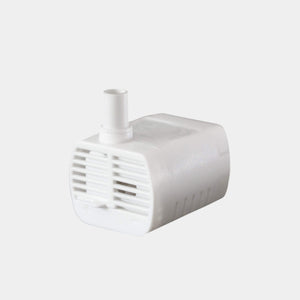
A small pump carries the brine up from the container. From there, it spreads over the structure of the graduation tower and then flows back down into the container.
3D printing makes it possible to produce this complex shape.
The 3D-printed SalinoVatis structure is made from Bio-PLA. The device works on the principle of cold evaporation: the brine moves over the structured surface while water evaporates at room temperature.

What is 3D printing, in simple terms?
In standard 3D printing, an object isn’t made all at once. Instead, it’s built up layer by layer.
It starts with a digital model that defines the shape of the finished part. Software then prepares this model for printing.
The printer applies the material bit by bit, and many individual layers eventually make up the finished part.
The big advantage of this process is that even shapes that would be difficult to make with conventional manufacturing methods can be built up precisely.
Why does the structure of the graduation tower matter so much?
For cold evaporation, the available surface is what counts.
Picture two equal amounts of water: one in a narrow glass, the other spread thinly over a large area. On the larger surface, more water is in contact with the surrounding air at the same time.
The graduation tower works on a similar principle.
The brine doesn’t simply run through a smooth pipe. It spreads over a complex three-dimensional structure, which means a large surface fits into a comparatively compact part.
What is a gyroid structure?
The graduation tower is designed around what’s called a gyroid structure. The name sounds more complicated than the idea behind it: a gyroid is a curved, three-dimensional structure with a large surface.
Unlike a simple grid, it isn’t made up of straight lines alone. The structure runs through the part in every direction.
For the mini saline, what matters most is the large structured surface over which the brine can spread.
You don’t need to understand the maths behind a gyroid to use the mini saline. What counts is what it does in practice.

Why use 3D printing for this?
Complex internal structures like this show one of the strengths of 3D printing.
With conventional manufacturing, intricate cavities and curved internal structures can be hard to produce. In 3D printing, by contrast, the part is built up layer by layer from the digital model.
That means the shape and the internal structure can be developed together.
In SalinoVatis, this makes it possible to create a compact graduation tower with a far larger surface than its outer dimensions would suggest.
What material is used?
The 3D-printed SalinoVatis structure is made from Bio-PLA. PLA is a plastic that can be processed as a filament in 3D printing and makes complex shapes possible.
For the graduation tower, what matters above all is how material, 3D printing and structured shape work together.
From digital model to graduation tower
Put simply, the production process can be broken down into four steps:
The shape is developed digitally.
The model of the future part is created on a computer.The model is prepared for 3D printing.
The digital design is processed so that a 3D printer can build it up layer by layer.The part is printed.
The three-dimensional structure gradually takes shape from many individual layers of material.The graduation tower becomes part of the brine circuit.
In the finished device, the brine spreads over the printed structure and then runs back into the container.
So 3D printing is more than a design feature: it creates the surface that defines the graduation tower.
What does 3D printing have to do with a traditional graduation tower?
Historic graduation towers also rely on the largest possible wetted surface. There, brine is channelled over structures filled with blackthorn, for example.
A mini saline doesn’t simply copy the historic design on a smaller scale. But the basic technical principle is comparable: spreading brine over as large a surface as possible.
In SalinoVatis, a 3D-printed structure does this job.
3D printing therefore brings together an age-old principle of brine distribution and a modern way of making parts.
Frequently asked questions about 3D printing in SalinoVatis
Is the whole mini saline 3D-printed?
No. 3D printing is used for the specially shaped parts of the design, in particular the graduation tower. Other components, such as the pump, are also part of the device.
Why doesn’t the graduation tower have a simple, smooth surface?
The structure creates a large surface in a comparatively small space, so the brine can spread over a larger area.
What material is used for the 3D-printed structure?
The 3D-printed SalinoVatis structure is made from Bio-PLA. PLA can be processed as a filament in 3D printing and allows complex shapes to be built up layer by layer.
Why a gyroid?
The gyroid is a complex three-dimensional shape that creates a large surface in a small space, so the brine can spread over the structured surface of the graduation tower.
Conclusion
In SalinoVatis, 3D printing makes one thing possible above all: a complex, structured surface in a compact part.
The graduation tower is built up layer by layer from a digital model. Its three-dimensional structure spreads the brine over a large area before it flows back into the container.
The design brings together a principle familiar from graduation towers – spreading brine over a large surface – and modern manufacturing technology.
This article is for general information purposes only.