


In brief: A mini saline and a humidifier are built for different jobs.
A humidifier is designed specifically to add water to the air and raise relative humidity.
A mini saline such as SalinoVatis, on the other hand, is all about a brine circuit running over a structured surface. That makes it neither a conventional humidifier nor an ultrasonic nebuliser.
This difference is exactly what raises so many questions:
Does a mini saline still add moisture to the room? Can you just put salt in an ordinary humidifier? And which makes more sense when the air feels dry in winter?
Let’s go through the differences step by step.
What does a humidifier do?
The name says it all: a humidifier releases water into the air to deliberately raise relative humidity.
There are different ways of doing this. Ultrasonic models turn water into a fine mist. Evaporative humidifiers blow air over a moist material. Steam models heat water and release water vapour. The US Environmental Protection Agency (EPA) distinguishes clearly between these methods and points out that their care and hygiene requirements differ too.
So if you use a humidifier, it’s not just about how much water it puts out. A hygrometer, regular cleaning, water quality and the actual humidity in the room all matter just as much.
The German Environment Agency (Umweltbundesamt) recommends around 40 to 60 percent relative humidity for living spaces. Humidity that stays high for long periods can encourage mould, particularly on cool surfaces. In poorly insulated homes, a lower level may be better in winter.
What does a mini saline do differently?

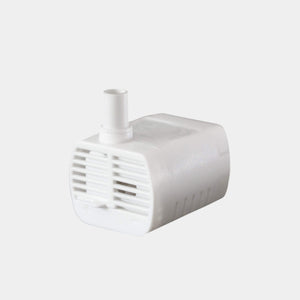
In the SalinoVatis Mini Saline, brine flows over a structured surface, and a small pump keeps it circulating. Across this large surface, water can evaporate at room temperature.
Salino describes the system as cold evaporation based on the graduation tower principle and expressly does not describe it as a conventional humidifier or ultrasonic nebuliser. According to the manufacturer, fine salt-containing particles are released into the surrounding air in the process.
So the key point isn’t simply “water in the air”, but how brine, circuit and evaporation surface work together.
You can find out more about how a mini saline works based on the graduation tower principle in this article:
https://salino.eu/en/blogs/artikel/gradierwerk-fur-zuhause-wie-eine-mini-saline-funktioniert
Mini saline and humidifier side by side
| Feature | Mini saline | Conventional humidifier |
|---|---|---|
| Main purpose | Brine circuit and salt air ambience | Raise relative humidity |
| Liquid | Brine as specified by the manufacturer | Usually water as specified by the manufacturer |
| Principle | Brine runs over a structured surface | Depending on the model: evaporation, ultrasound or steam |
| Ultrasound | No | Yes, in ultrasonic models |
| Visible mist | Usually not | Possible, depending on the technology |
| Humidity control | No | Possible with a humidistat, depending on the model |
| Use of salt | Part of the intended system | Only if the manufacturer expressly allows it |
| Care | Check brine, water level, surface and pump | Regularly clean tank, water, filter or evaporation element |
| Suitable if the main goal is higher humidity | Not intended as a substitute for a humidifier | Yes |
What the two have in common is that water comes into contact with room air.
Beyond that, they do different jobs.
Does a mini saline still raise humidity?
This is one of the questions we’re asked most often.
Yes – wherever water evaporates, water vapour enters the air.
With a mini saline, though, this isn’t its main function, and it isn’t regulated to a specific humidity level.
Salino gives a guide figure of around 500 millilitres of water released per week. The actual amount can depend on room temperature, room conditions, ventilation and the initial humidity, so you shouldn’t read it as a specific increase in relative humidity.
If, for example, your hygrometer keeps showing very low humidity and you want to raise it from 30 to 45 percent, choose a device that’s expressly designed for controlled humidification.
Can’t I just put salt in an ordinary humidifier?
Whether you can use additives in a humidifier depends on the manufacturer’s instructions. With ultrasonic models, bear in mind that more than just water can end up in the air.
The EPA (United States Environmental Protection Agency) points out that ultrasonic and so-called impeller humidifiers can spread minerals dissolved in the water into the room. That’s why it recommends low-mineral water and careful cleaning for these devices.
This also shows why a “humidifier with salt water” isn’t technically the same as a mini saline. The method, the intended liquid and what the device is designed for are all different.
What’s the better choice when heating dries the air?
First, it helps to separate measured low humidity from simply wanting a different feel to the room.
To find out whether the air really is too dry, start by measuring it with a hygrometer. The German Environment Agency recommends around 40 to 60 percent relative humidity for living spaces in general. The condition of the building, the outside temperature and any cold surfaces all need to be taken into account.
If your goal is “I want to raise and control humidity deliberately”, a humidifier designed for that purpose is the right choice.
If your goal is “I want to use the mini saline principle, with circulating brine and cold evaporation”, that’s a different technical concept, and it isn’t designed to regulate humidity.
So a mini saline shouldn’t be presented as a more powerful, more natural or healthier humidifier. They’re simply two different technical concepts.
Why more humidity isn’t automatically better
Especially in winter, it’s tempting to think: the drier the air feels, the more it needs humidifying. It’s not that simple.
The German Environment Agency points out that humidity that stays high for long periods can increase the risk of moisture forming on cold parts of the building, and with it the risk of mould. If relative humidity stays above around 60 percent for long periods, that risk can rise, depending on the building and how well it’s insulated.
That’s why a hygrometer is often more useful than simply feeling that “the air is dry”.
Cleaning is different too
Anything that holds water needs looking after – whether it’s a humidifier or a mini saline.
With conventional humidifiers, how much cleaning is needed depends very much on the technology. The EPA particularly stresses the importance of cleaning water tanks regularly. With ultrasonic and impeller models, poor maintenance can allow microorganisms and minerals from the water to get into the air.
With a mini saline, care focuses on the brine circuit, the evaporation structure, the water level and the small pump. In a system that works with brine, salt deposits can build up, and they should be removed as described in the care instructions.
So the rule is the same for both: don’t improvise – follow the care and usage instructions for your device.
Frequently asked questions
Is a mini saline a humidifier?
No. SalinoVatis isn’t designed to regulate relative humidity. It uses a brine circuit and cold evaporation over a structured surface.
Will a mini saline make a dry room more humid?
Evaporation does release water into the air. But a mini saline doesn’t regulate humidity to a specific level, so it shouldn’t be seen as a replacement for a conventional humidifier.
Can I put salt in an ultrasonic humidifier?
Only if the manufacturer of that specific device expressly allows it. Ultrasonic models can spread minerals dissolved in the water into the air, which is why the EPA even recommends low-mineral water for them.
What humidity level makes sense in a room?
The German Environment Agency recommends around 40 to 60 percent relative humidity for living spaces in general. The ideal level can depend on the building, though, particularly its insulation and the outside temperature.
Is a mini saline a medical device?
SalinoVatis is expressly not described as a medical device. It isn’t intended to diagnose, treat, cure or prevent any disease and doesn’t replace medical advice.
Conclusion: two devices, two different jobs
Mini salines and humidifiers are often compared because water plays a part in both. Technically, though, they’re built for different purposes.
If you want to raise the relative humidity in a room deliberately, a humidifier is the right choice.
A mini saline, by contrast, works with a brine circuit and a large evaporation surface. Any change in humidity is a side effect, not what it’s designed to control.
Once you know the difference, it’s much easier to decide which technology suits what you actually want.