


His father drove 60 minutes to the graduation tower. In spring 2023, that regular journey to Kevelaer became the starting point for the SalinoVatis story: Martin Huber was looking for a Father’s Day gift and went on to develop the first mini saline prototype. This article tells the story of how the idea became a product, the challenges of getting started and the role of the graduation tower principle.
How did the mini saline story begin?
It was spring 2023, and Martin was looking for a special Father’s Day gift. His father regularly made the 60-minute drive to the graduation tower in Kevelaer. Martin saw how much these trips involved: time, fuel costs and fixed opening hours that everything else had to fit around.
Martin was already working with 3D printing and began wondering whether the principle of a graduation tower could be adapted to a small device for the living room. In his words: “There must be a way to make this work at home, too.”
What is the graduation tower in Kevelaer?
A graduation tower is a structure used to concentrate brine: salt-containing water, known as brine, trickles down a wooden framework filled with bundles of brushwood, usually blackthorn.
The graduation tower in Kevelaer is part of Solegarten St. Jakob brine garden. Construction of the tower began in 2018. Solegarten St. Jakob, including the graduation tower, was completed in 2020. The tower is around 12 meters high, approximately 25 meters in diameter and shaped like a scallop shell. Visitors can enter the structure. The wooden framework is made of larch and filled with blackthorn cut in Poland for this graduation tower.

How was the first prototype developed?
Martin began researching how a graduation tower works and what that would mean for a small device. Several weeks in the workshop followed, producing prototypes with different 3D-printed structures. Friends and family were already wondering what he was building.
The result was the first SalinoVatis: a small device with a gyroid structure that provides a large surface area within a compact space.
Brine is guided over this surface. Our article How is a mini saline’s graduation tower 3D-printed? explains how a graduation tower is made using 3D printing.
What happened on Father’s Day 2023?
On Father’s Day 2023, Martin gave his father the device he had built.
His words were: “Dad, now you’ve got Kevelaer in your living room.”
That sentence summed up the idea behind the gift. Technically, of course, a mini saline is not a graduation tower like the one in Kevelaer.

How did the gift become a product?
Step by step, the personal project developed into a product. A team continued working on the technology, design and marketing. Artur Steffen, now managing director of Salino GmbH in Düsseldorf, was involved in the development of the business. The mini saline was refined, and a second version was added.
Why did the launch not go to plan at first?
The early days after the launch were difficult, as the SalinoVatis team explained in an interview published by Wirtschaftsförderung Mönchengladbach. The website was online, but sales failed to materialise because the right advertising was missing. The start-up grant helped the SalinoVatis team get through this early stage. According to the team, the first publication in a TV listings magazine eventually brought a noticeable increase in demand. Demand increased after that.
What does a mini saline have in common with a graduation tower?
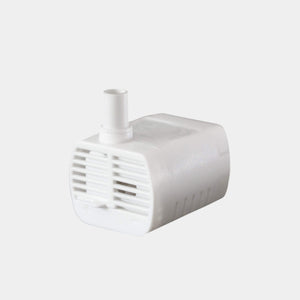
The connection lies in the principle. In a graduation tower, brine trickles over a large surface. In the SalinoVatis Mini Saline, a small pump carries brine up from a container. The brine spreads over a structured surface, water evaporates at ambient temperature, and the brine flows back into the container. The device works without ultrasonic mist or hot steam.
A mini saline is based on the principle of historic graduation towers. It is not equivalent to a graduation tower and is not a medical device.
Where is SalinoVatis today?
Today, the mini saline comes in two sizes: the compact Aura and the larger Vita, each available in five design options (chalk, bamboo, graphite, marble and rainbow). On 30 October 2025, the German Wellness Association (Deutscher Wellness Verband) announced the winners of the Wellness & Spa Innovation Awards 2025. SalinoVatis received an award in the wellness product category. Product development continues in Düsseldorf.
Frequently asked questions
Who developed the SalinoVatis Mini Saline?
Martin Huber developed the first prototype in 2023. The company is called Salino GmbH and is based in Düsseldorf. Its managing director is Artur Steffen.
When did the idea for the mini saline first emerge?
The idea emerged in spring 2023. Martin Huber gave his father the first prototype on Father’s Day 2023.
Where is the graduation tower in Kevelaer?
It is in Solegarten St. Jakob in Kevelaer. It is around 12 m high, approximately 25 m in diameter, and visitors can walk inside it.
Is a mini saline the same as a graduation tower?
No. The mini saline adapts the principle of distributing brine over a large surface to a small indoor device. A graduation tower is a large outdoor structure.
Is SalinoVatis a medical device?
No. SalinoVatis is not a medical device.
Conclusion
The SalinoVatis story begins with a car journey: 60 minutes to the graduation tower in Kevelaer. In 2023, that prompted the question of whether the graduation tower principle could be brought into the home on a smaller scale. A Father’s Day gift followed, a prototype with a gyroid structure, and later a product. Getting started was not without its challenges. Today, the mini saline comes in two sizes and five design options.
Visit the product page to find out how the SalinoVatis Mini Saline is constructed and which models are available.