


In brief: A graduation tower for your home adapts the basic principle of traditional graduation towers to a compact indoor device. A pump distributes brine over a structured surface, and the water evaporates at room temperature; in the process, fine salt-containing particles enter the surrounding air. SalinoVatis works without ultrasound and is neither a humidifier nor a nebuliser. Aura and Vita differ mainly in size and evaporation surface.
At a glance
- Passive cold evaporation at room temperature
- Closed brine circuit with a quiet pump
- Gyroid structure providing a large evaporation surface area
- No ultrasound and no targeted increase in humidity
- Aura where a more compact device is preferred, Vita with a larger evaporation surface
- Regular checks on water level, brine and device
What is a graduation tower for your home?
Historic graduation towers are large wooden structures with walls of brushwood that brine trickles down. Their open design creates a large contact area between water and air. A graduation tower for your home takes the same basic physical principle and scales it down to fit into your living space.

In a mini saline, a finely structured surface takes the place of the brushwood wall. The brine is continuously distributed and collected again, creating a circuit that takes up little space and fits easily into everyday life.

How does the graduation tower principle work on a small scale?
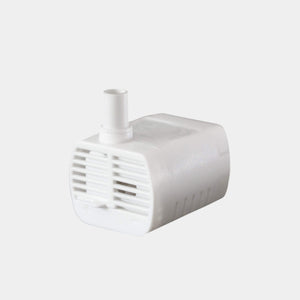
The base of the device holds a brine container. A pump carries the liquid upwards, and from there it runs back down over the three-dimensional gyroid surface into the container. This shape increases the contact area without making the device any wider than it needs to be.
As the brine flows over the surface, some of the water evaporates naturally. This happens at room temperature, with no heating plate and no ultrasound, so there’s none of the visible mist you get with some other devices.
It’s worth distinguishing between circulation and consumption: the pump moves the brine through the device again and again. Water is lost mainly through evaporation and needs topping up, while most of the salt stays in the circuit. That’s why the mixture should always be prepared according to the instructions for your device.
Cold evaporation, humidifiers and nebulisers: what’s the difference?
These devices may look similar at first glance, but technically they do different jobs. What matters is how water or brine comes into contact with the air.
| System | Principle | Main purpose | Typical output |
|---|---|---|---|
| SalinoVatis | Brine flows over a structured surface | Compact salt air system | Water vapour from passive evaporation; fine salt-containing particles in the surrounding air |
| Humidifier | Water is evaporated or atomised | Raise humidity | Water vapour or water droplets |
| Ultrasonic nebuliser | A membrane makes the liquid vibrate | Nebulise liquid | Visible, fine mist |
So SalinoVatis shouldn’t be thought of as a conventional humidifier. Humidity may change depending on the room, temperature and ventilation, but it’s not what the system is designed to control. You can find out why salt water is a problem in an ordinary humidifier in our article Humidifier with salt: what a mini saline does differently.
Aura or Vita: which model suits you?
Both models use the same circuit. The choice comes down mainly to the size of the room, the space you have and how prominent you want the device to be.
| Feature | Aura | Vita |
|---|---|---|
| Typical use | Smaller rooms and compact spaces | Larger rooms and a stronger visual accent |
| Evaporation surface | More than 900 cm² | More than 1,100 cm² |
| Dimensions | 25 × 25 × 18 cm | 32 × 25 × 18 cm |
| Weight | Approx. 0.9 kg | Approx. 1.1 kg |
| Technical principle | Brine circuit with passive cold evaporation | Brine circuit with passive cold evaporation |
Aura is the more understated choice if space is tight. Vita is taller, so it offers more structured surface. If you can’t decide, think about the room and the exact spot first – not just the look.
Where it goes, how long it runs and the room it’s in

A mini saline should stand on a stable, level, water-resistant surface. A spot close to where you spend a lot of time usually makes more sense than a corner you rarely use. Air should be able to circulate around the device, so keep it away from direct heat sources and sensitive surfaces.
SalinoVatis can run continuously. Even so, it’s worth a quick check every now and then: is there enough water? Is the brine flowing evenly? Is the tube in place? Does the pump sound different from usual? Simple checks like these help you spot changes early.
Keeping the brine circuit and pump running smoothly
Over time, salt can build up on surfaces and in the parts that carry water. A regular care routine keeps the circuit clear: switch the device off, unplug it, take the parts apart as described in the instructions and rinse off any residue with clean water. Depending on use, a thorough clean roughly every three to four weeks is a good idea.
If the pump gets louder or the brine stops flowing evenly, check the water level, the tube and how the pump is seated first. The exact steps are set out in Salino’s user manuals, and you’ll find more answers on use and care in our FAQ section.
How SalinoVatis puts the principle into practice

SalinoVatis turns the idea of the graduation tower into a compact device with a brine container, pump and gyroid structure. Aura and Vita share the same technical design but differ in height and surface area.
You’ll find all variants and the latest product details on the SalinoVatis product page. The matching SalinoFUSION sea salt is available for the intended brine circuit, and you can read more about how the device is developed and made on About Salino.
View the SalinoVatis Mini Saline →
Frequently asked questions about the graduation tower for your home
Is a mini saline a humidifier?
No. A humidifier is designed specifically to raise relative humidity. SalinoVatis is all about the brine circuit over a structured evaporation surface.
What’s the main difference between Aura and Vita?

Vita is taller and has a larger evaporation surface of more than 1,100 cm². Aura is more compact, with more than 900 cm². The technical principle is the same for both.
Can SalinoVatis run continuously?
Yes, it’s designed for continuous use. Even so, check the water level, the brine flow and its position regularly.
Why does the mini saline need a pump?
The pump keeps the brine moving. It carries the liquid upwards so that it can flow back into the container over the gyroid structure.
Which salt goes into the device?
Use the mixture intended for SalinoVatis, as specified by the manufacturer. That way the concentration and operation stay matched to the system.
Where should a graduation tower for your home go?
On a stable, level, water-resistant surface, with some distance from sensitive objects and direct heat sources. A spot close to where you spend most of your time is ideal.
Try the graduation tower principle in your own home
With our 30-day satisfaction guarantee, you can try SalinoVatis at home. You’ll find the current terms in the shop.