


In brief: When brine evaporates, dissolved salt is left behind and can crystallise. The guidance in this article refers to the German version of the user manual. The manual describes such salt deposits during operation and explains how to remove them with water. What exactly a coating consists of cannot be reliably determined from its appearance alone. If the drip pattern or pump noise also changes, the troubleshooting guidance can help.
During operation, pale, crystalline deposits can form on the graduation tower. Is this to be expected? Can they be removed easily? And when is it worth taking a closer look? This article explains how such deposits form, how to remove them according to the manual and when support can help.

How the white coating forms
Brine is water in which salts are dissolved. In everyday use, the term usually means water that contains table salt. You can read more in the article “What is brine?”. In the mini saline, the pump moves the brine upwards; it then runs over the graduation tower, and some of the water evaporates. You can find more information in the article “How does cold evaporation work?”. The dissolved salt does not evaporate with it. The salt concentration rises, and salt crystals can form.
Salt deposit or malfunction?
A pale coating alone tells you nothing about the condition of the device's components. What matters is whether anything also changes during operation.
Safety note:
Disconnect the mains plug from the socket before any cleaning or maintenance!
| What you observe | Possible explanation according to the manual | What the manual recommends |
|---|---|---|
| Pale coating on the graduation tower or housing, with no change in the drip pattern or pump | Salt crystals can appear on the device during operation. | Remove them with a damp sponge so that the brine can drain more easily. |
| Uneven drip pattern | The drip channels may be blocked or insufficiently wetted. | Gently move the graduation tower several times. If this does not help, remove the graduation tower as described in the manual, turn it upside down and wet the drip channels with water, or rinse away salt residues with a stream of water. |
| No brine flow or a noticeably louder pump | Possible causes include a low water level, the power connection, salt residues in the pump or disconnected tube connections. | Check the points in the “Troubleshooting” chapter (“Fehlerbehebung” in the German manual) and remove salt residues by cleaning the pump. |
Remove deposits according to the manual and also check whether the drip pattern or pump noise has changed. You can find detailed instructions on pump care in the article “Pump, noises and care”.
What can encourage heavier deposits
The manual identifies several factors:
- Salt concentration: A high concentration causes salt deposits to form more quickly and may mean that the pump needs cleaning more often. For two litres of water, the manual specifies up to 150 g of SalinoFUSION for mild brine, 300 g for moderate brine and up to 600 g for intensive brine. You can read how to prepare the brine correctly in the article “Preparing brine for the mini saline”.
- Location: Strong direct sunlight and heat can increase salt build-up and the amount of maintenance required. This also applies to a position near a radiator or on a sunny windowsill.
- Periods of inactivity: After a prolonged period of inactivity, salt deposits on the pump can cause malfunctions. Also check the channels at the top of the graduation tower.
How to remove salt deposits according to the manual
Follow the safety note above. Clean the parts by hand with cold to lukewarm water, no warmer than 35 °C.
- Light deposits: Remove them with a damp sponge so that the brine can drain more easily. Plain water in the brine container can also help with lighter deposits. Observe the maximum filling volume of approximately 2.1 litres.
- Deposits on the graduation tower: Thoroughly wet the affected areas with water, for example from a squeeze bottle, until the salt dissolves.
- Heavy deposits: Clean the device completely. Empty the brine container completely and take the mini saline apart into its main components as described in the manual. Soak the graduation tower, grid, section of tubing and brine container in plain water for at least 15 minutes, then clean them with a cloth, sponge or soft brush. Rinse all parts thoroughly under running water and leave them to dry briefly before reassembling the mini saline as described in the manual. A pipe cleaner can help with the section of tubing, and a shower head with lukewarm water can help with the graduation tower. Do not put the parts in the dishwasher or washing machine.
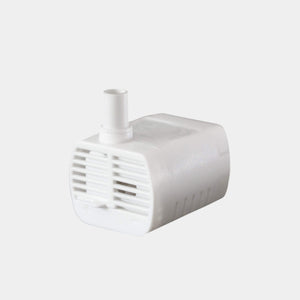
- Pump: If the pump has been left dry for a long time or is switched off frequently, salt may have crystallised inside it. First place it in a water bath and leave it for a few minutes. If it still does not respond, clean the pump: pull the cap off to the side, remove the intermediate base, carefully pull off the rotor using the pump key or tweezers, and rinse the exposed area with water.
Also use a cloth to remove condensation and salt crystals from nearby surfaces. The manual calls for regular periods of ventilation and drying and recommends checking the surrounding area regularly for signs of moisture.
The routine according to the manual: The brine must be replaced completely and the device cleaned thoroughly at least every four weeks. If necessary, remove visible salt crystals from the graduation tower and housing sooner. Check the fill level regularly. The manual gives once or twice a week as a guide for topping up with water. Observe the level indicator and the maximum filling volume. After longer breaks in operation, replace the brine before restarting and check the pump and drip channels as described in the manual. If you are unsure, support can help.
Just table salt, or limescale too?
You cannot tell just by looking at the coating. Two factors play a role.
First, SalinoFUSION is a salt mixture and does not consist exclusively of sodium chloride.
Second, there is the water. The manual specifies filtered, boiled (and cooled) or distilled water. In simple terms, water hardness describes the calcium and magnesium content and is classified as soft, medium or hard. Your water supplier can tell you how hard your tap water is.
A study of graduation towers shows that deposits from brine can vary in composition: as natural brine evaporated, calcite, aragonite and gypsum were detected alongside rock salt. However, the study does not determine the composition of the coating on your mini saline.
When can support help?
If the pump still does not work after the checks in the “Troubleshooting” chapter, the manual recommends contacting customer service. You can reach the team at aero@salino.eu or by phone on +49 211 15856577.
Our recommendation: send a photo of the coating with a short description of what has changed during operation. Details of the mixture used, the last cleaning and any periods of inactivity are also helpful. If residues cannot be removed using the steps described, please contact support before trying other cleaning methods.
Conclusion
When brine evaporates, salt is left behind, so salt deposits can form during operation. You cannot tell just by looking at the coating whether it contains only table salt. Always assess it alongside the drip pattern and pump noise, and clean according to the current manual.
This article is for general information purposes only. For operation, cleaning and maintenance, always follow the latest user manual.