



It's just after midnight, the flat feels like a sauna, and you're facing the decision: switch on the fan, or finally buy the air conditioner everyone's talking about. The answer isn't as simple as it seems. Both devices cool, but they do it in completely different ways, and that's exactly what makes the difference for your nose, throat and eyes.

Fan or air conditioning: the same problem, two different causes
Since the record heatwave in June, sales of air conditioners in Germany have risen sharply; according to a Verivox survey, almost a quarter of households now own one, many for the first time. And many only notice after a few nights that they may be cooler but are sleeping worse. Dry throat, burning eyes, waking up wiped out even though the night was cool.
Anyone who reaches for a fan instead knows a different problem. The air moves, feels fresher, but if you lie directly in the airstream you sometimes wake with a stiff neck or irritated eyes. Both devices can save the night or ruin it, depending on how you use them.
The question is coming up freshly in a lot of homes right now. Those without an air conditioner are weighing up whether it's worth buying one. Those who already have one are wondering why they still don't feel rested. Both questions end up at the same point: the humidity in the room, not the temperature alone.
Why air conditioning and fans strain the mucous membranes differently
An air conditioner doesn't just cool. It draws in warm room air, actively removes moisture from it as it cools, and the condensation drains outside. That's its side effect: relative humidity in the bedroom can drop below 30 percent within a few hours. Germany's Federal Environment Agency recommends a relative humidity of between 40 and 60 percent for living spaces. If it falls well below that, the mucous membranes in the nose and throat dry out and lose their protective function against pathogens.
A fan, by contrast, removes no moisture from the room air. It only circulates it. The problem is local: if the airstream hits the nose, eyes or throat directly, exactly those spots dry out, even though the humidity in the rest of the room stays perfectly normal. That's why it's often enough just to point the fan differently to solve the problem. With an air conditioner that isn't enough, the moisture is then missing from the whole room, not just one spot.
Children often feel this difference more strongly than adults, because their airways are narrower and react to changes faster. Anyone already prone to dry mucous membranes, such as allergy sufferers or people who breathe through their mouth at night, notices the effect more clearly too. One detail is often overlooked: the longer an air conditioner runs without a break, the further the humidity keeps dropping, even when the temperature has long been constant.

Fan or air conditioning: what's really gentler, side by side
In short: the fan is usually gentler on the mucous membranes, but worse in extreme heat. The air conditioner cools more reliably, but dries out the room air overall. Neither device is fundamentally wrong. It comes down to what you compensate for.
Using a fan without dry eyes
Never point the fan directly at your face or upper body; let it blow indirectly into the room.
Hang a damp cloth nearby, it noticeably raises the local humidity.
Drink enough before sleeping so the mucous membranes don't dry out further.
Using air conditioning without a dry throat in the morning
Keep the temperature difference from the outside air no greater than 6 degrees; that's easier on both your circulation and your mucous membranes.
Set up a hygrometer and keep an eye on the humidity, rather than cooling purely by feel.
Actively put back the moisture that's been removed, instead of just hoping it sorts itself out.
This last point is exactly where the SalinoVatis Mini-Saline comes in. It releases fine salt particles into the room air, similar to the air right by the coast, creating an atmosphere that many customers find noticeably more pleasant, especially in rooms with an air conditioner or fan. If you like the cool air but not the side effects, our salt-air collection offers an addition that can run alongside the fan or air conditioner without replacing it.
Who the difference matters most for
The difference is most noticeable for allergy sufferers, for people already prone to dry mucous membranes, and for children, whose airways are narrower and more sensitive. Anyone who breathes through their mouth at night or snores also feels dry air-conditioned air more than others. And if you sleep in a hotel or work in a permanently air-conditioned office, you know the feeling too: tired, irritated, dry throat, even though the night or the working day was actually pleasantly cool.
Does it really work? What customers report
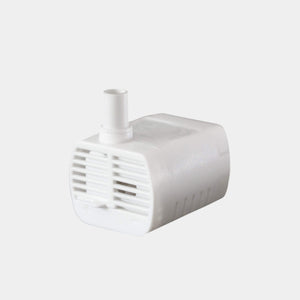
Honestly, the effect isn't equally strong for everyone, we'd rather say that openly than promise something we can't keep. But in numerous verified customer reviews, many users report their nights feeling calmer despite the air conditioner or fan. It needs no filter and runs on a small, energy-saving USB pump, unlike many active humidifiers.

Sleep cool, without your nose and eyes paying the price
You don't have to choose between staying cool and healthy mucous membranes. Try pointing the fan differently tonight, or measure with a hygrometer just how dry your air conditioner actually makes the air. The Mini-Saline simply runs alongside, top up the salt every few weeks, and that's all the care it needs. Take a proper look and decide whether it fits your bedroom.
This article is for general information only and does not replace medical advice. If symptoms persist or are severe, please consult a doctor or pharmacist.
(Images: Gemini)